Mixed teaching reaches more minds

-
Sist oppdatert
18. mai 2026
-
Kategori
People don’t think alike, feel alike, or learn alike. Education can’t be truly inclusive if it speaks only one language of learning.
SCIENCE NEWS FROM KRISTIANIA: Pedagogy
This text was published at Science Norway 26th April 2026 titled "Norway has an opportunity to lead a global education reform".
Summary:
- Research shows that there are mainly three different ways of processing information.
- These ways can be translated into three distinct cognitive “languages” that shape how we learn: some need data, others meaning, and some are driven by future possibilities.
- Ph.d.-candidate Magde Mohamed Nour writes that education often favours one way of thinking, but real learning requires teaching that reaches all three.
(This summary was created by AI and reviewed by the editors).
Imagine three students in the same classroom, receiving the same lecture. One gets excited by data and statistics; another connects through stories, while the third lights up when discussing future possibilities. They’re all intelligent, but they process information differently, and our education system often only speaks to one of them.
In a study that examined political speeches, conducted in collaboration with Professor Jens Kjeldsen from the University of Bergen, we found underlying patterns that reveal fundamental differences in how humans process information. These differences have important implications for education.
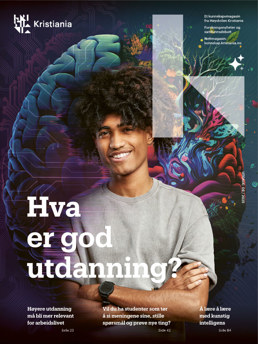
Les Kunnskap Kristianias temautgave:
The three tribes in a classroom
Let’s say you’re explaining climate change to three equally intelligent students.
Future-focused learner lights up when you talk about green technology solutions, innovation possibilities, and what could be achieved by 2050. These students don’t just want to understand the problem; they want to envision the solution. They’re motivated by potential and possibilities.
Values-based processor connects most strongly when you frame climate change through moral responsibility, protecting future generations, and Norway’s tradition of environmental stewardship. They filter everything through their principles and cultural frameworks. Facts matter less than meaning; they seek the «what should be» in every lesson.
Students are equally capable. They just speak different cognitive languages
Evidence-based thinker wants the data; CO2 levels, temperature graphs, peer-reviewed studies. They need logical progression, systematic analysis, and concrete proof. Show them the science, and they’ll follow the argument; this is the «what is» of understanding.
Here’s the crucial point; all three students are equally capable. They’re just speaking different cognitive languages.

You may also like:
Vital reminder for Norwegian tradition
These insights are especially relevant to Norway’s consensus-driven culture, which values collaboration and inclusive participation.
Yet standard educational practices – often dominated by systematic, evidence-based teaching – may not engage all learners equally. This approach suits analytical minds but can overlook those who connect more deeply through personal meaning or future-oriented thinking.
The Norwegian tradition of ’dannelse’ (whole-person development) offers a vital reminder: education should address all dimensions of human understanding. Still, in many university lectures, one language prevails: data-driven instruction. When teaching becomes only information delivery, it risks losing its transformative potential.
A more inclusive approach blends multiple ways of thinking within the same learning experience. This mixed method reflects the reality that students process information differently, and meaningful education must speak to all of them.A challenge to Norwegian higher education

You may also like:
A challenge to Norwegian higher education
Norway has an opportunity to lead global education reform. While other countries debate access and funding, we could pioneer cognitive inclusion; ensuring our universities speak all the languages of learning.
This isn’t about dumbing down or compromising rigor. A physicist who can only speak to other physicists isn’t fully educated. A philosopher who can’t connect ideas to future possibilities limits their impact. An innovator who ignores evidence courts disaster. 
Practical steps for making the change:
- Begin with a forward-looking idea to spark curiosity
- Connect the topic to societal relevance and ethical context
- Then explore the evidence and mechanics
- Cycle through these elements to engage different cognitive styles
In Course Materials
- Move beyond listing learning objectives
- Frame skills in terms of their impact on society and future challenges
- Help students visualize how their learning translates into real-world action
In Assignments
- Offer flexible options: analyze data, reflect on implications, or imagine applications
- Ensure all paths lead to the same learning goals
- Let students engage through their natural cognitive strengths
Text: Magde Mohamed Nour, PhD candidate, School of Health Science, Kristiania University of Applied Sciences.
References:
Mohamed Nour, M., Kjeldsen, J. E. (2025). Charisma, Ideology, and Pragmatism: Unpacking Leadership Rhetoric During COVID-19 in the United States, the United Kingdom, and New Zealand. Res Rhetorica. 2025.
We love hearing from you!
Send your comments and questions regarding this article by e-mail to kunnskap@kristiania.no.
Siste nytt fra Kunnskap Kristiania
 Kunnskap KristianiaLes mer
Norges største KI-problem kan være politikerne
Norge kan ikke styre kunstig intelligens alene, og særregler kan koste oss dyrt. Kunnskap KristianiaLes mer
Fem tips for å ha det bedre i en utrygg verden
Krig, kriser og en uforutsigbar fremtid kan gjøre oss urolige. Men forsøkene våre på å unngå ubehagelige tanker og følelser kan gjøre vondt verre. Kunnskap KristianiaLes mer
Hvor rik må man være for å kalle seg rik?
Reduser formueskatten! Norge trenger nemlig noe mer enn skattepenger fra Sveits-utflytterne.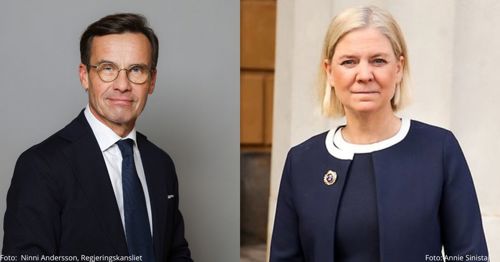 Kunnskap KristianiaLes mer
Sverige har valgt. Slik brukte politikerne sosiale medier.
Kristianiaforskere har analysert det svenske valget. Vi har samlet fem saker om politiske kommunikasjonsstrategier på nett.


