This is how blind people can play video games

-
Sist oppdatert
24. september 2025
-
Kategori
Gaming is no longer just for the sighted. With built-in auditory navigation, blind players are ready — it’s time developers got in the game, too.
SCIENCE NEWS FROM KRISTIANIA: Gaming and technology
Summary:
-
Sound-based navigation can make video games fully accessible for blind players, creating equal opportunities for immersive play, writes PhD candidate Alexander Espeseth.
-
Experiments show that audio cues alone allow players to navigate and complete games successfully.
-
Espeseth suggests an industry-wide framework, enabling all developers, not just big studios, to design games for everyone.
(This summary was generated by AI and reviewed by the editorial team).
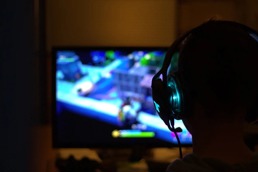
Video games have become a major part of modern entertainment, yet for players with visual impairments, access remains a significant challenge.
Sound-based navigation can make video games more accessible to blind players, ensuring they can enjoy and be immersed in interactive experiences on equal footing with sighted players.

My study lays the groundwork for a more inclusive gaming industry. By developing and testing a new framework for accessible game design, it demonstrates that integrating robust auditory navigation systems into games can bridge the gap.
Read more:
Win-win – for developers and gamers
The gaming industry has made strides in accessibility, but most solutions are costly and developed by AAA-studios, which is the video game equivalent of a Hollywood production from the world of movies.
This limits the possibilities for smaller studios to afford to make their games tailored for the blind players. Sadly, blind players are often forced to rely on unofficial modifications or workarounds to play mainstream and indie games.
For game developers, this means new opportunities to reach a broader audience by implementing built-in accessibility features rather than relying on third-party solutions.
Ultimately, the goal is to establish sound-based navigation as an industry standard, making games truly accessible to all players
For players, it means more freedom to enjoy video games without unnecessary barriers. Organizations such as The Norwegian Association of the Blind and Partially Sighted (Blindeforbundet) are thrilled and are now collaborating with us by sending testers, reinforcing the real-world impact of this work.

Read more:
How was this tested?
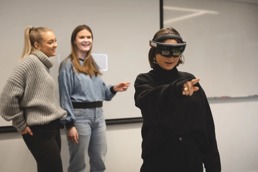
To evaluate the effectiveness of sound-based navigation, we conducted an experiment with two groups: blind players and sighted participants who played the game blindfolded to simulate different levels of visual impairment.
The participants used audio cues, including a moving sound cue guiding the player towards the goal using spatial audio to inform where to move, and sound effects to navigate a game environment without any visual assistance.
Data was collected on their ability to complete levels, the time required, and their experience via questionnaires.
The results showed that most participants could successfully navigate the game using only auditory information, confirming that well-designed sound cues can serve as an effective tool for orientation and movement.
Practical implications and the next steps
Based on our findings, the next phase of research will focus on refining this approach based on feedback from testers across different game genres and environments. We aim to create a standardized framework that game developers can easily implement in their production pipelines.
To ensure practicality, we are working closely with the Norwegian game industry, including Snowcastle Games, to ensure optimal workflow for the developers which then again will ensure upscaling in games available for the blind players.
Ultimately, the goal is to establish sound-based navigation as an industry standard, making games truly accessible to all players. By combining research, industry collaboration, and direct input from blind players, we can move towards a future where video games are designed for everyone from the very beginning.
Reference:
Espeseth and K. Raaen, "Playing Games Without Sight: Sonic Play," 2024 IEEE Gaming, Entertainment, and Media Conference (GEM), Turin, Italy, 2024, pp. 1-6.
Text: Alexander Espeseth, PhD candidate, School of Economics, Innovation and Technology, Kristiania University of Applied Sciences.
This text was also published on Sciencenorway.no on the 3rd of September 2025 with the title "This is how blind people can play video games".
We love hearing from you!
Send your comments and questions regarding this article by e-mail to kunnskap@kristiania.no.
Siste nytt fra Kunnskap Kristiania
 Kunnskap KristianiaLes mer
Fem tips for å ha det bedre i en utrygg verden
Krig, kriser og en uforutsigbar fremtid kan gjøre oss urolige. Men forsøkene våre på å unngå ubehagelige tanker og følelser kan gjøre vondt verre. Kunnskap KristianiaLes mer
Hvor rik må man være for å kalle seg rik?
Reduser formueskatten! Norge trenger nemlig noe mer enn skattepenger fra Sveits-utflytterne. Kunnskap KristianiaLes mer
Sverige har valgt. Slik brukte politikerne sosiale medier.
Kristianiaforskere har analysert det svenske valget. Vi har samlet fem saker om politiske kommunikasjonsstrategier på nett. Kunnskap KristianiaLes mer
Politikere lærer seg TikTok-språket
Derfor preget plattformen den svenske valgkampen i 2026


