Kristiania Receives Increased Erasmus+ Funding for Student and Staff Mobility

-
Last updated
7. July 2026
– Kristiania has received the largest increase in Erasmus+ funding among higher education institutions in Norway, says Carl Joakim Gagnon, Internationalisation Adviser at Kristiania University of Applied Sciences.
Studying abroad is an opportunity to experience a new culture and gain international experience.
Kristiania has around 200 exchange agreements with universities around the world, most of them Erasmus agreements within Europe.
This year, Kristiania has received increased Erasmus+ funding, providing a strong foundation for students who wish to study abroad in Europe.
– If you secure a place at one of our partner institutions in Europe, this year’s allocation means you can be confident that you will receive a full Erasmus+ grant, says Carl Joakim Gagnon.
Different Types of Exchange Agreements
For partner universities in Europe, exchanges take place through a bilateral Erasmus agreement. The agreement is part of Erasmus+, the European Union’s exchange programme for higher education and other sectors.
An Erasmus agreement provides students with an Erasmus+ grant in addition to the regular financial support available through the Norwegian State Educational Loan Fund (Lånekassen). The grant amounts to €410 or €460 per month, depending on whether the host country is classified as a high-cost or low-cost destination. Tuition fees are paid to Kristiania, not to the host institution.
– Kristiania also has partnership agreements with universities in a number of countries outside Europe. In those cases, two other types of agreements apply, explains Carl Joakim.
The first type is a reciprocal agreement, which operates in much the same way as an Erasmus+ agreement. Students do not pay tuition fees to the host institution, but the agreement does not include an Erasmus+ grant. Kristiania also welcomes students from the partner institution, who continue to pay tuition fees to their home institution.
The second type is a Study Abroad agreement. These are one-way agreements under which tuition fees are paid directly to the host institution rather than to Kristiania. Tuition fees are often higher than under the other exchange arrangements. Students may still be eligible for ordinary grants and travel support from Lånekassen, but not for Erasmus+ funding.
Read more about the different types of agreements and funding opportunities here.

Finances Are Better Than Many Students Expect
Many students are unsure whether they can afford to study abroad, but according to Carl Joakim, the financial situation is often better than expected.
– You keep your support from Lånekassen just as you would when studying in Norway. In addition, everyone participating in Erasmus+ receives a grant that does not have to be repaid.”
He explains that many students find studying abroad financially manageable, especially if they sublet their accommodation in Norway while they are away. Choosing an Erasmus agreement also helps reduce costs.
Students continue to receive support from Lånekassen just as they would while studying in Norway.
All of Kristiania’s partner universities are also committed to helping exchange students find accommodation in their host country.
– Some offer student housing on campus that you can apply for, while others help you find accommodation through local housing portals, he says.
Nevertheless, he recommends starting the housing search early.
– In most cases, everything works out fine, as long as you begin the process well in advance.
Think Strategically When Applying
Some destinations are always more popular than others, and trends can vary significantly from year to year.
– We see that many students choose the same countries because they have heard that others are going there. In that case, it can be smart to think strategically. If you choose a study destination that fewer students apply to, your chances of receiving your first choice increase, says Carl Joakim.
Students can list up to three preferred destinations when applying for exchange.
– One year, an exceptionally high number of students applied to South Korea, while the following year almost no one did. It shows just how much popularity can fluctuate.
Want to learn more? Find dates for exchange information meetings in Bergen and Oslo here.
Students Who Have Studied Abroad Would Do It Again
Evaluations show that students are highly satisfied with their exchange experiences.
– Almost everyone says they would choose to do it again. That’s why I would encourage students who are considering an exchange semester to spend some time exploring the opportunities available. Read about our partner universities and consider whether studying abroad might be right for you, he says.
The application deadline for students planning to study abroad in the spring semester is 15 September, while the deadline for those planning to go abroad in the autumn semester is 1 March.
Translation note: This is an AI-assisted translation of the original Norwegian article. The translation has been reviewed and edited by Kristiania staff.
Blokkk
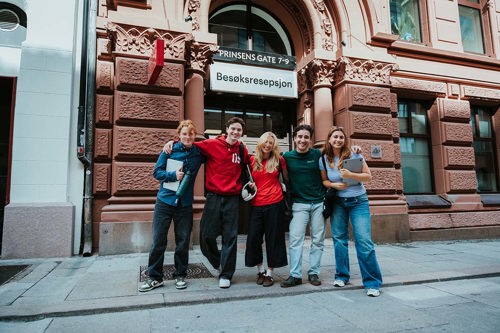
Become an exchange student
Kristiania University of Applied Sciences holds the Erasmus Charter for Higher Education and accepts applications from students of all our partner institutions. We look forward to welcoming you to our campus and supporting you in your exchange journey.Read more
How to apply for an exchange
Step by step guide for incoming exchange students on how to apply for an exchange to Kristiania.Read more

